
Hello friends, hope this post finds you in good health and spirit!
AI has long promised to change how we live, work and connect. We have used it as a tool, a chatbot, or a piece of software to get tasks done. But things are changing rapidly. AI is no longer just something you use but becoming a presence that goes with you.
Soon, AI will be your eyes, noticing things you miss.
It will be your ears, translating the world in real-time.
And it will be your hands, acting on your behalf while you focus on important work.
There has been flurry of tech, tools, models and promising announcements recently. In this post, let’s explore how things are changing and why it should matter to you.
️ AI as Your Eyes
AI is learning to see not just images or screens, but the real world around us. With breakthroughs in multimodal AI, vision models, and smart devices, AI can now observe and understand what you are looking at.
Meta’s latest Ray-Ban smart glasses, for example, can describe surroundings, recognize objects, and even tell you what is happening in a scene like “That is a bike lane” or “Your friend is smiling. ”Google’s Project Astra offers a conversational AI that can view your environment and answer questions like, “Why isn’t this device working?” by watching through your phone’s camera. OpenAI’s GPT-4o also brings in real-time visual context, capable of interpreting sketches, reading screens, or guiding you through a process.

It’s not just about seeing — it’s also about generating visual understanding. Google’s Veo and OpenAI’s Sora are pushing boundaries by creating hyper-realistic videos from simple prompts. You describe a concept and the AI renders a nearly real movie scene. From educational visuals to marketing content, this new class of visual AI will help anyone create stunning outputs without needing cameras or editing suites.
Why it should matter to you
Whether you are navigating a new city, helping an elderly parent understand signage, or producing content for your business, AI will become your second set of eyes. It can spot details, read environments, and even visualize your imagination and most of time you don’t even need to carry device in hand. With smart glasses and Hardware AI, you will soon “wear your AI”.
AI as Your Ears
AI is also learning to hear like humans and with extra capabilities. Real-time speech recognition and language translation have evolved far beyond basic subtitles.
Google’s Gemini Live enables voice-based conversations across languages, making it possible to talk to someone in Japanese while you speak English, and both parties understand instantly. Microsoft Teams also offers real-time translation in meetings, across voice, chat, and captions.
These innovations have significantly improved Service Desk support across industries. Organizations no longer need bilingual or locally stationed agents. Instead, a centralized command center operating in English can now support multiple languages across various channels—voice, chat, and email, making global support more scalable and efficient.
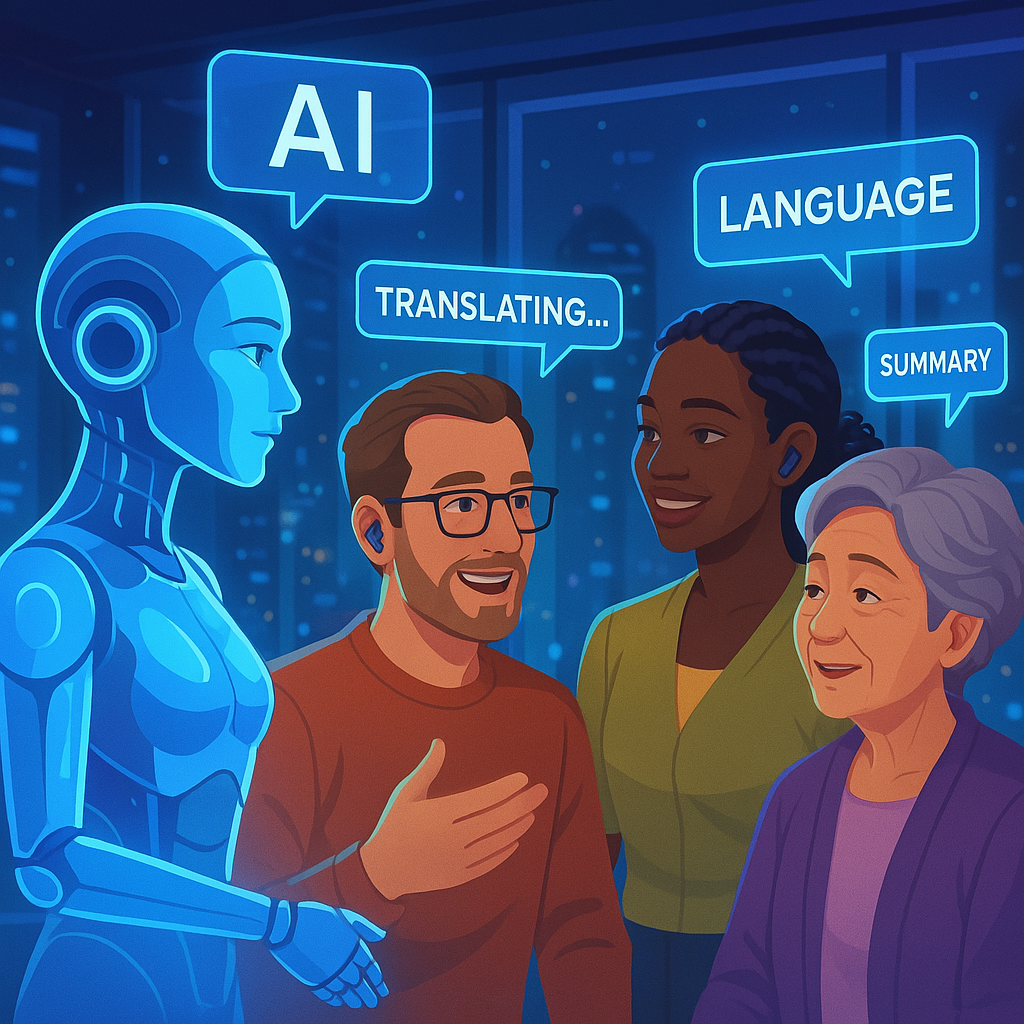
But hearing goes beyond translation. AI is starting to understand tone, background noise, and subtle cues. Soon, it will know when you sound frustrated, distracted, or tired. It can summarize what was just said, remind you of what you missed, or alert you if someone nearby is speaking to you and you are wearing headphones. This “ambient listening” opens new possibilities in accessibility, safety, and communication.
Why it should matter to you
AI won’t just help you speak any language but it will help you be understood. It can work as personal interpreter, working 24×7 in fields like Service desk, online classes, job interviews, medical consultations or virtual travel. It can assist children struggling with hearing, help you in meetings through summarization and transcript, or allow you to connect across cultures with ease.
AI as Your Hands
One of the most promising transformation is that AI is learning to “act”. It’s no longer just about giving you suggestions but also perform tasks for you.
Agents like OpenAI’s “Operator” or Crew AI’s “crew” are being designed to complete complex tasks autonomously. Tell them to book a flight, compare prices, or fill a form and they will do it, by navigating real websites and apps as a human would. Amazon is working on NoviAct, its own task-executing agent for enterprise environments, while Microsoft’s Copilot ecosystem is enabling agents that operate across Office, Windows, and developer workflows.

This shift also touches creation. You no longer need to be a hardcore developer to build things. As a “citizen developer,” you can use tools like Google’s AI Studio or GitHub Copilot Workspace to describe an app or feature in plain English and the AI will build it. Want to create a budget tracker, automate your email responses, or generate a website? Now you can just use words, not code.
Why it should matter to you
You are not just getting an assistant but the one which can think, reason and act autonomously, 24×7. Whether it’s planning a trip, starting a side business, or handling your digital chores, AI will get it done while you focus on living.
AI is here to Live with You
AI has evolved from a chatbots to a sensory extension. An AI that listens, sees, and acts alongside you, without needing to be told exactly how. It will sit in your glasses, your earbuds, your apps, and your home. It will build things for you, translate the world for you, fix problems for you and it can do all this autonomously.
And this isn’t a distant future. While some of these tools are already in the market, others are already announced and will be launched soon as real, working solutions.
So, are you ready to embrace them? I’m sure you are. 🙂
That’s all I wanted to cover in this post. I’ll be back soon with more technical insights. Till then, ta-ta!
I have written few more posts about AI Agents and AI Hardware. You can check them here:

 AN IT DIARY of AI, Windows, MEM & PowerShell